
Understanding COGS: How Cost of Goods Sold Determines Your Gross Profit
COGS is one of the most misunderstood lines on a small-business income statement. Once you understand what goes in and what stays out, your gross profit finally tells you something real.

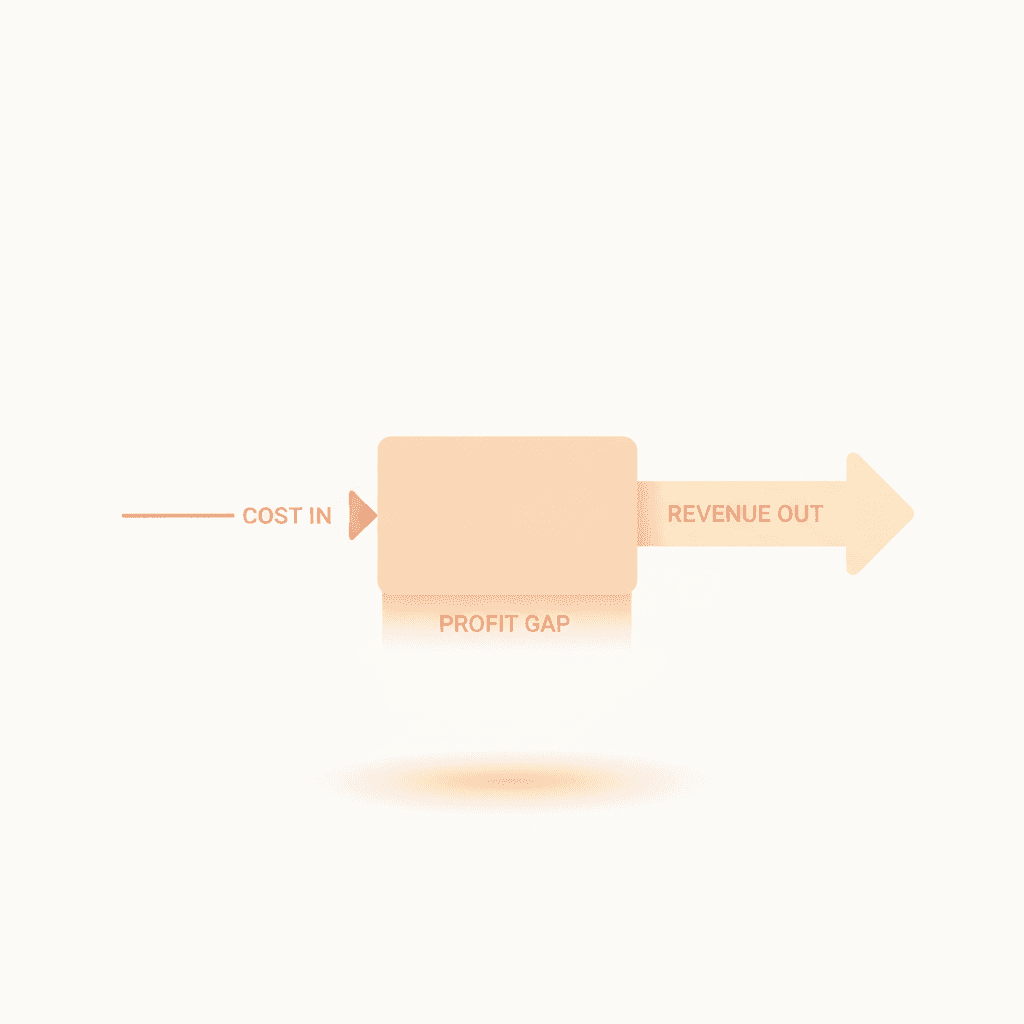
Your income statement has a line that quietly determines whether your business model actually works. That line is Cost of Goods Sold (COGS).
Get COGS right and gross profit becomes a meaningful health signal. Get it wrong — by lumping in costs that should sit elsewhere, or leaving out costs that belong — and every profitability decision you make is built on shaky foundations.
What COGS includes (and what it does not)
COGS captures the direct costs of producing the goods or services you sell. The test: would this cost disappear if you sold nothing? If yes, it probably belongs in COGS.
Included in COGS:
- Raw materials and components
- Direct labour (workers who physically make the product)
- Manufacturing overhead directly tied to production (factory utilities, machine maintenance)
- Freight and shipping costs for inbound materials
- Packaging that is part of the product
Not included in COGS (these are operating expenses):
- Rent for your offices or showroom
- Management and administrative salaries
- Marketing and advertising
- Sales team costs
- Depreciation of non-production assets
The distinction matters because gross profit — calculated after COGS but before operating expenses — tells you whether your core product or service is profitable, independent of how you run the company.
The COGS formula
COGS = Beginning inventory + Purchases during period − Ending inventory
You start with what you had, add what you bought, and subtract what is still sitting on the shelf. What is left must have been used to make what you sold.
Worked example: a small product business
Imagine a small business that makes handmade ceramic mugs.
| Item | Value |
|---|---|
| Inventory at start of quarter | 3,200 |
| Materials and supplies purchased | 8,500 |
| Direct labour (kiln operator) | 4,000 |
| Inventory at end of quarter | 2,700 |
COGS = (3,200 + 8,500 + 4,000) − 2,700 = 13,000
If the business generated 20,000 in sales revenue that quarter:
Gross profit = 20,000 − 13,000 = 7,000 Gross margin = 7,000 ÷ 20,000 = 35%
Use the COGS calculator to work through your own figures without doing the arithmetic by hand.
Gross profit vs gross margin
These two figures measure the same thing, just in different forms:
| Metric | Formula | Example |
|---|---|---|
| Gross profit | Revenue − COGS | 7,000 |
| Gross margin | Gross profit ÷ Revenue | 35% |
Gross profit is an absolute number — useful for understanding scale. Gross margin is a percentage — useful for comparisons across time periods or against competitors.
A 35% gross margin means for every 1 of revenue, 35 cents are available to cover operating expenses and profit. The margin calculator makes it easy to test different pricing or cost scenarios.
COGS vs operating expenses
This distinction trips up many first-time business owners.
| COGS | Operating expenses |
|---|---|
| Materials | Rent and utilities |
| Direct labour | Admin salaries |
| Manufacturing overhead | Marketing spend |
| Inbound freight | Insurance |
Both reduce your profit — but at different stages of the income statement:
- Revenue − COGS = Gross profit
- Gross profit − Operating expenses = Operating profit (EBIT)
If your gross margin is healthy but operating profit is slim, the problem is in overhead. If gross margin is thin, the problem is in your core production costs.
How reducing COGS improves margins without raising prices
Raising prices is sometimes impossible in a competitive market. But the gross margin equation has two variables, and lowering COGS moves the margin just as effectively.
Strategies to reduce COGS:
- Negotiate better supplier terms — bulk discounts, longer payment periods, or switching suppliers
- Reduce waste and scrap — lean manufacturing principles applied even at small scale
- Improve process efficiency — reducing direct labour hours per unit through better workflows or equipment
- Value-engineer the product — find cheaper materials or components without compromising quality
If your business currently earns 35% gross margin and you can trim COGS enough to push that to 40%, on 500,000 revenue that is an extra 25,000 of gross profit — without selling a single additional unit.
For a broader view of how pricing decisions feed through to profitability, see our markup vs margin guide and the markup calculator. And if you want to understand how COGS flows into your break-even point, the break-even calculator connects the dots.
Key takeaways
- COGS captures only direct production costs — materials, direct labour, and production overhead. Operating expenses like rent and marketing sit below gross profit.
- Gross profit = Revenue − COGS; gross margin expresses that as a percentage of revenue.
- Lowering COGS is often more achievable than raising prices, and the margin improvement flows directly to the bottom line.
These examples are for illustration. Tax treatment and accounting rules vary by jurisdiction — consult an accountant for advice specific to your business.
Frequently asked questions
Does COGS include salaries?+
It depends on the role. Direct labour — wages paid to workers who physically make your product or deliver your service — is included in COGS. Salaries for management, administration, sales, or marketing are operating expenses, not COGS.
What is the difference between COGS and cost of revenue?+
"Cost of revenue" is the broader term often used by service businesses or software companies. It includes COGS plus other direct delivery costs such as hosting, support staff, and third-party fees. In product businesses the terms are often used interchangeably.
Why does inventory method affect COGS?+
When you have inventory bought at different prices, the method you use to decide which units were "sold first" (FIFO, LIFO, or weighted average) changes which costs flow into COGS. In a period of rising prices, FIFO produces lower COGS and higher gross profit; LIFO does the reverse. Most countries outside the US require FIFO or weighted average under international accounting standards.
Can a service business have COGS?+
Yes. Freelancers and agencies commonly include direct project costs — subcontractors, software licences used per-project, travel billed to clients — in COGS. The principle is the same: costs directly tied to delivering the service belong in COGS; overhead that exists regardless of work volume does not.
How does reducing COGS improve margins without raising prices?+
Gross margin = (Revenue − COGS) ÷ Revenue. If you keep revenue constant but lower COGS through better supplier terms, reduced waste, or process efficiencies, the numerator grows and so does your margin. This is often more achievable than raising prices, especially in competitive markets.
Try the calculators
Keep reading
- Markup vs Margin: The Difference Every Seller Should Know
A 50% markup is not a 50% margin — here’s the difference, why it matters, and how to convert between the two.
- What Is Break-Even and How Do You Calculate It?
The break-even point is where your business stops losing money and starts making it — here’s how to find it in units and in revenue.
- What Is Customer Lifetime Value (CLV) and How Do You Calculate It?
Every customer has a number attached to them — the total revenue you can expect over your entire relationship. CLV makes that number concrete so you can spend on acquisition with confidence.

Elena writes about taxes and the money side of running a small business. She’s on a mission to make VAT, margins, and break-even points feel a lot less scary.